Aghazadeh, M. (2014). International sanctions and their impacts on Iran’s economy. International Journal of Economics and Finance Studies, 6(2), 25-41.
Atwood, B. (2025). Artificial intelligence in Iran: National narratives and material realities.
Iranian Studies, 1-18.
doi: 10.1017/irn.2024.63
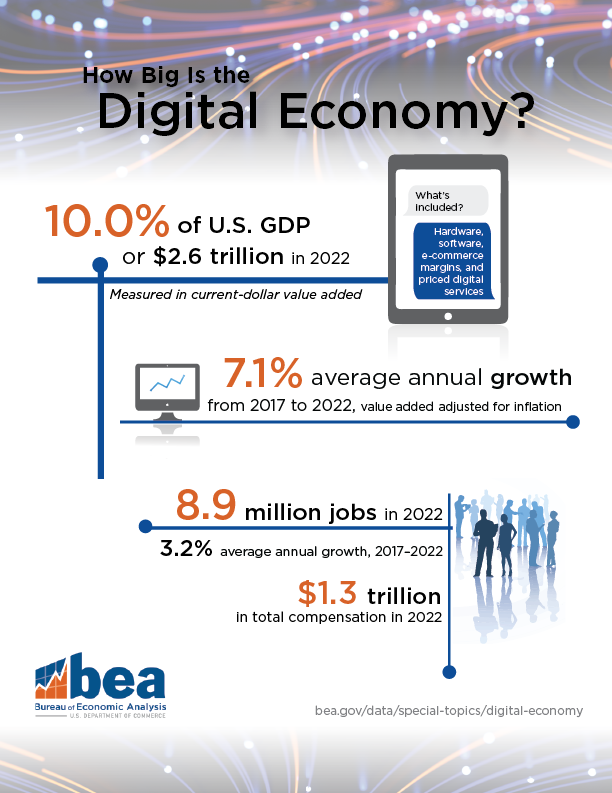
Barefoot, K., Curtis, D., Jolliff, W., Nicholson, J. R., & Omohundro, R. (2018). Defining and measuring the digital economy.
Bureau of Economic Analysis, U.S. Department of Commerce.
https://www.bea.gov/system/files/papers/WP2018-4.pdf
Bayat, Z. (2021). The impact of COVID-19 on the digital economy. National Conference on Interdisciplinary Research in Management and Humanities (In Persian).
Brynjolfsson, E., & McAfee, A. (2014). The second machine age: Work, progress, and prosperity in a time of brilliant technologies. W.W. Norton & Company.
Dube Williams, L. (2021). Concepts of digital economy and Industry 4.0 in intelligent and information systems.
International Journal of Intelligent Networks, 2, 122-129.
doi: 10.1016/j.ijin.2021.09.002
Dumitra, E. (2023). AI - The new player in digital economy. In
Geopolitical perspectives and technological challenges for sustainable growth in the 21st century(pp. 877-886).
doi: 10.2478/9788367405546-081
Friedman, M. (2002). Capitalism and freedom(40th Anniversary edition). University of Chicago Press.
Harvey, D. (2005). A brief history of neoliberalism. Oxford University Press.
Institute for Trade Studies and Research.(2022). Assessment and analysis of Iran’s economic competitiveness gap (In Persian).
Katz, R. (2017). Social and economic impact of digital transformation on the economy. GSR-17 Discussion paper. Geneva: ITU.
Kiyanifar, A., Baghani, A., & Behjatifard, H. (2023). Integrated financial and tax systems in Iran’s digital economy. National Conference on Emerging Research in Accounting, Finance, Management, and Economics with a Focus on Innovation Ecosystem Development (In Persian).
Koch, T., & Windsperger, J. (2017). Seeing through the network: Competitive advantage in the digital economy.
Journal of Organization Design, 6(6).
doi: 10.1186/s41469-017-0016-z
Lowndes, V., Marsh, D., Stoker, G (2023). Theory and methods in political science(Trans. Amir Mohammad Hajiyousefi). Tehran: Strategic Studies Research Institute.(New edition, first printing) (In Persian).
Madani, K. (2021). Have International Sanctions Impacted Iran’s Environment?.
World, 2(2), 231‑252.
doi: 10.3390/world2020015
Moghadam, M. R. (2020). "Digital economy and its challenges in Iran". Sixth International Conference on Financial Management, Commerce, Banking, Economics, and Accounting, Tehran (In Persian).
Moradi, M. A., & Hedayati, M. R. (2018). A developmental model for Iran's transition to a digital economy. Economic Research Journal, 18(68), 219-251 (In Persian).
Mousazadeh Mousavi, S. M., & Hamtan AtarBashi, A. (2020). Digital economy(Part 4): An analysis of the current status of Iran's digital economy ecosystem. Tehran: Research Center of the Islamic Consultative Assembly (In Persian).
Mousazadeh Mousavi, S. M., Bagheri, A., & Adabi Firouzjai, M. (2018). Digital economy(Part 1): Dimensions and characteristics. Tehran: Research Center of the Islamic Consultative Assembly (In Persian).
Mousazadeh Mousavi, S. M., Bagheri, A., & Adabi Firouzjai, M. (2019). Digital economy(Part 2): The share of digital economy in the global economy and development requirements. Tehran: Research Center of the Islamic Consultative Assembly (In Persian).
Nafarlisaleh, N., & Abbasi, E. (2023). Identifying strengths and weaknesses in the performance of neobanks in Iran. Dynamic Management and Business Analytics Quarterly, 2(1), 1-17 (In Persian).
Nazarov, R. I. (2022). The digital economy today.
Academicia Globe: Inderscience Research, 3(10), 198-203.
doi: 10.17605/OSF.IO/N75A6
Popova, L., & Rasoulinezhad, E. (2016). Have sanctions modified Iran’s trade policy? An evidence of Asianization and De-Europeanization through the gravity model.
Economies, 4(4), 24.
doi: 10.3390/economies4040024
Rastegari, Sh., Babaeifard, A., & Niazi, M. (224). Stakeholders’ lived experience of the privatization process in Iran. Applied Sociology, 35(2), 69-100 (In Persian).
Rodrik, D. (2011). The globalization paradox: Democracy and the future of the world economy. W.W. Norton & Company.
Sassen, S. (2001). The global city: New York, London, Tokyo. Princeton University.
Stiglitz, J. E. (2002). Globalization and its discontents. W.W. Norton & Company.
TechRasa. (2022). The size of the Instagram product marketplace and the social commerce industry in Iran (In Persian).
Tehran E-Commerce Association. (2023). Internet quality in Iran: An analytical report on disruptions, restrictions, and internet speed in Iran (In Persian).
West, M., & Ballam, D. (2018). An introduction to international political economy(Trans. Ahmad Saei & Abdolmajid Seifi). Tehran: Qomess (In Persian).
Zuboff, S. (2019). The age of surveillance capitalism: The fight for a human future at the new frontier of power. Public Affairs.

)